Friday, April 20, 2012

10 Science Books Children Will Love

Children's literature is a great seq way into many other cross curricular opportunities in teaching different things throughout the school year. I wanted to provide ideas that I thought were really good science connection books that children would enjoy reading and thinking about throughout the year.


1. What Do You Do With a Tail Like This?
This Caldecot Honor book is a great non-fiction text that is extremely child friendly. Throughout the text animal anatomy is explored. Each page focuses on a different body part of different animals and describes the purpose of those body parts. The illustrations are absolutely amazing; they even have a very unique texture to them. I thought this story would be a great introduction into early biology understanding. This book is a must read!


2. Tree Life

The one thing that I really enjoy about informational texts is the real life pictures that children can associate with when reading. Tree Life is one of those types of books. The pictures that are incorporated in the text are absolutely amazing. The book really gives the reader an inside look at the inner workings of ecosystems relating to different types of trees.

Here is an example. On this page the text is describing the community spirit of wood work ants and their relationship to the tree that they live in. Look the the illustrations around the text on this page! Isn't that just amazing! I really think students would enjoy this.
I thought that this text could introduce the early understanding of ecosystems and the organisms that live within those organisms. The picture are the thing that really just puts the book over the top.


3. A Child's First Library of Learning: Sky and Earth
I really like the first library of learning series. Each book in the series has a topic (much like the one above) and asks questions about the topic on each page. The book then answers its own question using a multitude of access features in a unique page organization layout. Sky and Earth would be a great mentor text in teaching about the science of geography in different regions throughout the country. The book really promotes self exploration and challenges students to first ask a question, then read on to find the answer to the earlier asked question. It's just an overall great science and social studies connection to literature.


4. Computers In Everyday Life
I liked this books because it really relates to technology and how it is used throughout the world. The book is at a challenging level but it really could be used to introduce technology in the classroom as well as the variety of technology that is all around us throughout the world. The book itself is a little dated but the content that it displays is very relevant and meaningful. I would definitely suggest getting the book to introduce technology use into education!


5. Titanic
I thought this next piece of literature could be used as science that is currently relevant. We are now in the 100th anniversary of the titanic this year, the renovation of the new titanic movie is out in theatres currently, and there is a new TV show featuring the titanic on ABC. I thought that a science lesson on how things float and how boats work and operate would be very interesting. If you used the Titanic as the content theme then I believe students would really gravitate toward the lesson. Anyway, if you agree that teaching science through the titanic would be a really neat idea then this is the book you would want to read. It is complex but has a ton of really interesting information regarding the Titanic.


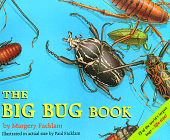
6. The Big Bug Book

What kid doesn't like bugs? In my experience most kids love to get down and dirty and talk about bugs. This book is a great story that explains what a big is and what kids of bugs are everywhere around us. I especially enjoyed the illustrations because they feature bugs interacting with man made things. This book would be a great bridge into an insect lesson. If you are looking for a piece of literature that is really interesting and meaningful then you definitely want this book!


7. Fish


Lets go back to the ocean, only this time instead of the titanic we are talking about fish! Wonderful world of the ocean is a topic that students will really find interesting. This book literally has almost everything you could ever know about different types of fish, fish characteristics, and general fun facts about fish. If an ocean life science lesson is your thing then this book is a must have!


8. Predator!
I recently conducted a predator prey game at Biglerville Elementary school and students absolutely loved it! Predator prey relationships are one of the most engaging and fun things to teach students within the science curriculum. This text has a lot of useful information that could be used within a predator prey unit study. Again, like many other non-fiction texts the pictures are of real life predators. The kids would just the pictures!


9. Ceratosaurus
When I was little I absolutely loved dinosaurs! There is just something about them that makes kids gravitate toward finding out information about them. I think that a dinosaur unit in science would be highly enjoyable and kids would be absolutely ecstatic when learning about them. This particular book come from "The New Dinosaur Collection" a collection that features a number of different dinosaurs in different historical periods. I chose the Ceratosaurus book to be featured because it looks like a dinosaur kids would love!


10. Understanding & Collecting Rocks & Fossils
I chose this last book because I believe that geology is something that is not studied commonly in science curriculum throughout the country. This book gives a general overview of all the basics of rock collecting and understanding. I think that incorporating this story into science curriculum could really generate some interest in geological studies (something that does not happen often).

Thursday, April 19, 2012

10 Interesting science blogs/websites!

Science resources are literally all around us. Internet and web-sources are great things to use to gather ideas for science activity and curriculum. Here are 10 interesting blogs/websites that I have found that relate to science understanding and teaching.


1. http://www.sciencebob.com/index.php
The website has a TON of science experiments and activities that students can do. The site also has interesting videos,  a question and answer section and an interactive blog. The videos are step by step instructions to experiments and explanation of how those experiments connect to science understanding.

Here's an example:
http://www.sciencebob.com/experiments/videos/video-blobs.php
This video explains how to make a lava lamp with a water bottle, using water and oil. The instructor really makes it interesting!


2. http://bainbridgeclass.blogspot.com/2012/01/handy-way-to-learn-about-texture.html?showComment=1326237729188#c3605442248393128809
This is an extremely specific and detailed teacher blog. The link I provided is a specific lesson that I personally used as a guide to complete me texture box a few weeks ago. Christina Bainbridge (blog creator) has tons of lesson ideas for all subject areas. I personally found amazing science lessons that could be incorporated in a number of different ways. Personally I like to take some of her lesson ideas and rearrange them on my own. It is definitely something worth checking out.


3. http://www.housingaforest.com/dancing-oobleck/
Amazing site that gives you a step by step process to making colored oobleck!


Dancing oobleck is essentially the same thing as oobleck only with a lot of bass and food coloring. Nevertheless, the website has really cool images and pictures and has the exact ingredients required to make the dancing oobleck work.


4.  http://tekyteach.blogspot.com/2011/12/more-force-and-motion-fun-marble-races.html
This is an interesting blog that has a variety of different lessons. It is not as detailed or intense at the blog mentioned earlier but it is still very interesting. One particular post really caught my eye where students built ramps for marbles to race down  and adjusted the level of the ramp to see how the speed of the marble changed.
I thought that this marble race activity was a really interactive science lessons that kids would really love to do in the classroom. Check out the details for this lesson and others on the blog!


5. http://www.modernparentsmessykids.com/2011/09/more-science-at-home.html
This next website is designed for parents who are homeschooling. I thought it would be a useful resource for ideas that can incorporate science into common everyday household things. The common theme with all the activities and projects is do it yourself. The activities are really interesting and teach a bunch of different science ideas and understandings. Check this website out if you are looking for science activities that are simple and can be done at home!


6. https://www.quirkles.com/about_the_quirkles/about.htm
This next website isn't really something that you can complete online and its not really something that guides you toward an idea for a science activity. This website is a portal to ordering something called Quirkels. Quirkels are books and materials that teach literacy and phonics understanding through science process and terminology. For example, some books are categorized by letter; Andy Acid, Colorful Caroline, Density Dan. Each book teaches particular phonics rules connected with science understanding. It is really something that is worth understanding and possibly ordering!


7. http://www.howtosmile.org/
How to smile is a very well known, high quality site. The site has literally hundreds of science and math activities. Frequent users can subscribe and the site even offers a smart phone app where the science and math games can be downloaded or played on the go. The site also has a search bar so that you do not have to pan through all the incredible games that are offered. This is a site I would highly recommend subscribing to; the benefits are absolutely amazing!


8. http://kids.discovery.com/
Discovery for kids is a popular highly visited site. It is comprised of quizzes, videos, science and social studies lessons and so much more. There are literally tons of interactive games that kids can play on this website. The website can be used for adults too; there are really good science activities and ideas that can be pulled from the site. I have observed students using this site in classrooms throughout the area. It really is a neat activity site.


9. http://kids.nationalgeographic.com/kids/
National geographic for kids is another very popular site (just like discovery for kids). I thought I would finish off the list with some more popular kids sites that I think live up to their reputation. This site is certainly not exception. It features a strong variety of games, videos and activities that visitors on the site can follow . I think the real strength in this site is the real life video features that it offers. It simply is a great site to expand the knowledge of science and social studies.


10. http://8plus1science.org/
8 plus one is an interesting science website that offers interesting ideas and insights in the understanding and incorporating of science into the classroom as well as everyday life. I chose 8 plus one because it touches on all grade levels from the elementary to secondary level. This site is a great site that promotes scientific thinking; logic and reason processing. Check it out!

Science Prop Box!


I wanted to give people viewing a chance to take a look at one of my first prop boxes I have created. The box is a themed science box that deals with different types of texture. The idea behind the box is that it is a comprised materials box that children can open up and immediately understand the task they are supposed to perform and conceptualize the content in which the box is suppose to help them understand. My box that I created was an activity in which students organized different items into five categories of texture. In order to aid them in this process they will have a multitude of resources and tools so that they can understand the classifying of the objects. Some objects could go in more than one category of texture causing students to really analyze the texture of items when classifying. Anything that creates a higher order of thinking is always a good thing!
This is what the box looks like with everything packaged inside. It is small and can be easily moved so it can be stored anywhere in the classroom. It is really a child friendly size!


Inside the box children are given a number of resources to help them classify the items. These are four books at different levels that relate to some form of texture. Two are non-fiction and two are fiction.


This is another resource that can be used to help the children classify the forms of texture. On the left are hands that have examples of each type of texture on each finger. On the right is a "texture table" in which each form of texture the students are classifying is defined.


This is an example of some of the small items children would be classifying in different texture groups. I stored them in small plastic Tupperware containers.

This is the finished product! Students use their resources and sort the items in different texture categories.